
It was with much amusement and sadness when I read an article about the rise of prenuptial agreements in the Sunday Times Feb 22, 2009. While the prenuptial agreement made a good fun read on a Sunday lazy morning, the context and implications of the agreement is worrisome.
Unlike the original reason of prenuptials, where the main purpose is to 'safe guard' ones fortune in case of divorce, the prenups reported by the newspaper is not about fortune or who to gets the children in case of marriage breakdowns. It was on things like cooking only once a week, cutting down on smokings, etc; things which I thought were things you would do out of understanding and love. In the printed newspaper, it was mentioned that the couple only got married after both agreed to the prenuptial agreement.
All this sounded so much like our business world - where meetings are held until some form of compromises can be reached with a contract drawn up and signed. Everything is strictly business; any emotions is discounted. However isn't this goes against the very idea of marriage?
Marriage, traditionally, is based on love between two people who chose to live and share their lives together; and love is based on emotions. One cannot draw up a contract to show ones love for one another. Love also means doing things that will make the partner happy like cutting down on alcohol if this meant making the partner happy. So if such things have to be spelt out in a contract, isn't there love lost?
The demise of the marriage institution started in the swinging sixties, with the start of the sex revolution where free sex was advocated. As society no longer frowned upon premarital sex and casual sex, marriage for sexual activity becomes unnecessary. Any couple is free to live as husband and wife without having to get married first. In the seventies, this was followed by the feminine movement where women are accepted into the workforce. Given the new financial freedom and new working role, the role of childbirth was relegated. Women for the first time have a real say as to when or whether they want to get pregnant. With the widespread availability of contraceptions, suddenly procreation became out of fashion. So, if having children becomes obsolete, why then get married at all?
Well it seems that the reasons for marriage is being repealed one at a time. I just wonder how long the marriage institution can withstand further assaults.
Just thinking aloud, what happens if the reported prenups was broken - sue the partner or divorce - like in the business world?
Monday, February 23, 2009
The End of Marriage Institutions?

Thursday, February 12, 2009
Has financial considerations got the better of moral considerations (II)?
The Straits Times today published a report entitled ' JB Nursing homes draw some S'poreans' as a follow up on the suggestion made by the Health Minister. (See my entry here).
I am not sure if the article is supportive of the Minister's suggestion but there is one interesting point that was repeated by those interviewed. The main reason why these Singaporeans are staying in JB nursing home is that of cost - the all important affordability issue. I think this is hardly surprising and if cost is removed from the considerations, I am sure most of these old folks will be brought back home. This was echoed by a Mr Yong, whose mother is in one the nursing homes in JB when he said "I'm just unable to afford the rates here. But I do wish I was able to bring my mother back."
I do not usually like to quote from the Opposition because sometimes they just have to present their views for the sake of opposing. But in this issue I cannot but agree with both MPs from the Workers Party when they said that the Minister's suggested is "quite a bad indication of affordability of our own health care services here, and also a reflection of our national values" and "Singaporeans who cannot afford medical treatment or step-down care here should now consider such facilities in Johor?"
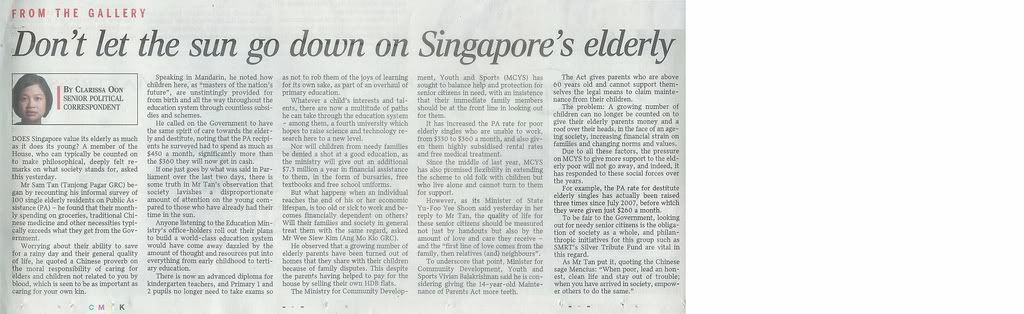
And it seems that this observation was not missed by Straits Times's Senior political correspondent Clarissa Oon in here writing entitled "Don't let the sun go down on S'pore's elderly" published in the Feb 12 copy of Straits Times. She wondered whether the elderly is valued as much as the young in Singapore. She based her observation on the slew of initiatives rolled out by various Ministries for the young; whereas the elderly's 'help' always comes with string attached. An example is the Maintainance of Parents Act which the MCYS Minister planned to enhanced to coerced their children to pay maintainance for their aged parents; only catch is that a growing number of children can no longer afford to do so for various reasons.
I hope the Health Minister will reconsider his suggestion and put more effort into looking for other ways of helping the elderly. Money is important in society but the family unit is definitely not less important. After all, graciousness in a society is not measured by dollars and cents. I am sure when the Minister of State Yu-Foo Yee Shoon said "the quality of life for these senior citizens should be measured not just by handouts but also by the amount of love and care they receive...." in a reply to request for more handouts, she unconsciously has highlight the most important aspect of a gracious society - the love and care to one another. And I sincerely hope that both the MCYS and the Health Ministers had heard and understood its meaning.
Wednesday, February 11, 2009
Has financial considerations got the better of moral considerations?
The Today newspaper reported that during the Health Ministry Budget debate yesterday, the Health Minister suggested that Singaporeans could consider living in nursing homes in neighbouring Johor Baru. I find this both uncomfortable and surprise because of the Confucianist philosophy that had always been espoused by the government. Has the need of the government to always maintain a budget surplus, finally dent the moral consciousness of our Health Minister?
Already the society is lamenting about the lack of filial piety. This can be easily seen if one steps into the hospital. Here, one can easily come across those unfortunate elderly patients who had been conveniently left in hospital because no relatives or children step forward to bring them home on discharge. I had also personally come across elderly who sold their flats with the promise by the children that the proceed from the sale will be used to upgrade to a landed property; only to find out later that they were excluded in the upgrading plan. So has the Minister conveniently forgotten this aspect when he made the suggestion?
I am surprise that he was not the least concerned when one investor in this scheme told him that many people visited their relatives weekly, even in nursing home in Singapore. On the surface this is understandable given that most Singaporeans are very busy by nature; hence there is no time to visit the old folks. However dwelving deeper, isn't this just an excuse? How many times have you heard of parents resigning from their work to take care of their sick children with long term problem? Or how often have you heard of couples going back to their parents home to take dinner when their parents are able? Obviously, lack of time is just an excuse. I think the main reason is motivation, or the lack of.
Hence if within Singapore, these old folks in the nursing home are only visited once a week because of 'time constraint', what is there to 'encourage' the younger generations to visit them in JB even once a week? Wouldn't the time constraint even be greater? The jam at both Checkpoints to cross the border is already a deterrent in itself! In the end wouldn't this be a case of 'out of site, out of mind'?
The Minister also mentioned that if there are any medical problems faced, these old folks can be easily transported back to Singapore for treatment. But has the Minister forget to factor in the cost of the ambulance transport? Just a simple transfer of a patient from JB to Singapore without the presence of a doctor cost at least S$1000. Knowing that old folks can easily fall sick, would this cost more in the long run?
If one has spoken to the old folks, how many of these old folks choose to stay in a nursing home given a choice? Have the Minister even consider their feelings? Or maybe in the name of expenditure, their mental health can disregarded?
Instead of nursing home, the solution may lie with day care centres. These centres look after old folks during the day time while the children are at work and then fetched or ferried home by evening when the children are at home. This arrangement is possibly the best because it serves two purposes.
One, the old folks do not feel neglected or unwanted. They know that at the end of the day, they will go back home to their children. They even benefit from the company of other old folks. They will have somebody to talk to, someone from the same generations, who are generally more patient with more time. This will maintain their intellect and their general mental health.
Secondly, the children can feel at ease knowing that their elderly parents are being looked after while they work. They can also benefit from their parents presence which can only enriched the family unit.
Considering that the government is trying to cultivate a more gracious society, I find this suggestion by the Health Minister very odd. How can shipping the elderly to a neighbouring country promote a gracious society? Would this suggestion turn this government campaign upside down? Already with the passing of the Maintainance of Parents Act in 1995, the government had already legally defined the minimal duty children have towards their parents. In the eyes of the law, a child would have carried out his duty simply by providing financial support to their parents. Hopefully, the government will not 'sanction' another policy that will destroy the family unit further. After all like the saying goes - charity begins at home.
I strongly urge the Health Minister to seriously look into funding for the setting up of Day Care Centres and subsidies to help those financially-challenged to place their elderly in such Centres. This can only benefit the two government policies of strengthing the family unit and building a more gracious society.
Saturday, January 17, 2009
What Barack Obama represents
Barack Obama will be inaugurated as the 44th US President tomorrow. This will mark a historic event not only in the United States but also the world. He will be the first African-American President of the United States and will probably be the first democratically-elected leader from a minority group. Why is his Presidency such an important event to the rest of the world?
Obama was born to a mixed-marriage family. His father was Kenyan and his mother an American white. Unlike past presidents, his family background is a humble one, one that is not much different from that of the majority Ordinary folks - no silver spoon, no ivory tower, no hereditary titles. Yet, through education and hard work, he had worked himself progressively up the social ladder till, what would probably be the zenith, the Presidency itself. And all this despite having to reconcile with the fact that he was Black, a minority, with perceived glass ceilings and prejudices. This is made even more remarkable given that the Civil Rights Movement was still very much alive barely forty years ago and the Voting Acts Right was only enacted in 1965 to allow the Blacks equal rights in the democratic process.
He had ran his Presidential campaign on a platform of 'Change' and succeeded. And this he did as an American, without the distinction of skin colour as other minority candidates usually ran their own election campaigns. What is remarkable is that his main rival was Hillary Clinton, who is still wildly popular with the White voters. Despite the odds, Obama won the Democratic nominations. Of course, Sen Hillary Clinton should also be praised for her gracious acceptance of 'defeat', something the rest of the world can learn.
While 'Change' is the theme of Obama's campaign, I think his main legacy will be 'Hope'. He has given hope to the minority population around the world, that being a minority should not be seen as a disadvantage. He did has his dark moments when he had difficulty reconciling his mixed-blood lineage but he had overcome them and be stronger.
Because he had come from an middle-class family, he had no special privileged as most past Presidents had. So, he had to work hard to climb the social ladder. And all this is made possible through education. He had shown that education can flatten the social landscape, making it possible even for the under-privilege to fight on even ground.
However, the most important that Obama portrayed is daring to dream and never give up. He had shown that if one dares to dream with a never say die attitude, great things can be achieved. He failed in his bid for a seat in the House of Representatives in 2000, yet he did not give up. He tried again in 2004 and succeeded. Any lesser person would have given up; the odds were stacked too high. Yet he persevered. How many in the minority group dare to dream of becoming the President of the United States? He did and he succeeded.
Why is Obama's success important in our part of the world? Hope is the answer. He has shown that being a minority is no obstacle. He has shown that with education, climbing the social ladder becomes easier. He has shown that one must dare to dream and never give up. The hurdles are there, but it is not impossible to overcome them.
So to Barack Obama, I say thank you.
Thursday, January 15, 2009
Wearing shorts sluttish, dress code hinders creativity?
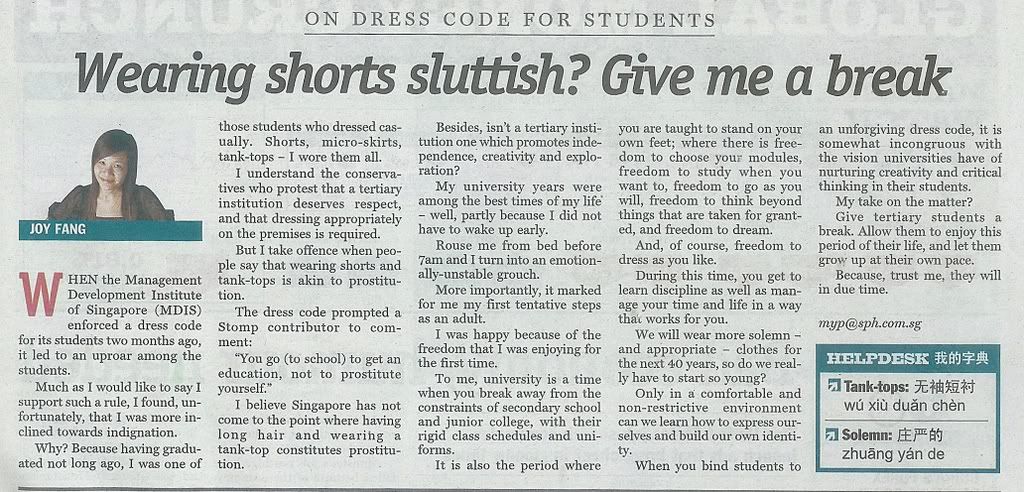
I read with much interest regarding an article in MyPaper dated 14 Jan 2009, reproduced above regarding the dress code and how it goes against the spirit of encouraging "creativity and critical thinking". Strangely after reading the article I was a tad supportive of her exertion. Freedom to choose what to wear, not being restrictive in clothing because one will "wear more solemn" clothing for the next forty years appeals to me. You see I also love to wear non-formal clothings. I go nearly everywhere in slippers - Orchard Road, market, shopping mall, beach, etc. It gives me the convenience and the freedom and saves time! Hence I can understand the writer's sentiment. Why restrict when the future is already restrictive with all the formal wear and neck tie. Furthermore, as a guy, I definitely will not mind girls wearing shorts and spaghatti - feast for the eyes!
But with a deeper understanding of what the university tried to do with its dress code, my feeling for such micro-wear (haven't reach nano-wear stage yet, sigh), and my sentiment change. No I do not agree that wearing tank-top equal prostitution. No doubt most if not all prostitute wear micro-wear; but to equal prostitution with micro-wear I think is unfair. Micro-wear can be elegant if it is worn at the appropriate occasions eg wedding dinner, annual D&D, or even a shopping trip down Orchard Road. But then again it depends on what accessories are used with such micro-wear.
My agreement with Joy Fang ends here. Freedom seems to be the catchword these days. Freedom of speech, freedom of choice, blah, blah, blah. But people forget that with freedom comes responsibility. Responsibility towards yourself, the people around you and in this context responsibility towards your lecturers. What do I mean by responsibility towards the lecturer? It simply means showing respect to your lecture and the University. And this is done by dressing appropriately for the occasion. Lectures and (especially) tutorials are formal occasions and hence deserve a certain dress code aka formal clothing. By not wearing formal clothing, this give the impression that there is no respect for the lecturer and what the lecturer stands for. I am sure Joy Fang will agree with me that micro-wear can hardly be anywhere near formal.
It is strange that in these days and age, with people getting more educated, commonsense seems to be lacking. Previously, people generally know how to dress when they go for lectures, outings etc. But nowadays, there seemed to be no distinction between formal and informal wear. Now we have all-occasion wear - the same T-shirt or shorts can be used to go to market, shopping, movie, university, hospital, banks, etc. Some people just forget about the plain commonsense to wear appropriately. Hence this leave the university with little choice but to give a gentle reminder (which is such a commonsense thing, that is absolutely unnecessary).
The university is a place of moulding the young. If not wearing appropriately is not frowned upon, how is the younger generations to know that there is such a thing as appropriateness and courtesy. Already the current generations are deprived of such guidance because of changing social circumstances where 2-pay cheques, domestic helper and paper chase is the norm; all unfortunately did not prepare one for life's challenges. If the university do not remind the students about the dress code, then how are they to distinguish between formal and informal wear? To those who say that it is such commonsense that formal dress code is needed in the office, I will point out that once upon a time, going to lectures meant wearing shirt (not Ts), longpants and shoes for guys and blouse and skirt or pants with shoes for the girls. It was also commonsense then but somehow commonsense disappeared.
So you see, what the university is doing is not to restrict "creativity and critical thinking" to quote the author (although I still cannot figure out what critical thinking has anything to do with wearing micro-wear) but just to give a (gentle?) reminder on apropriate dress code.
In case you are wondering, I do not wear slippers or shots when I attend lectures or attend functions in my children's schools.
Thursday, January 01, 2009
Happy New Year!
It has been six months since I last posted. During the six months there had been many upheavals in the world - sub-prime crisis, major earthquake in China, the melamine-tainted milk scandal in China and the war between Palestinians and Israelis (again).
Southeast Asia has its own fair share of setbacks. In Myanmar there was the massive destruction by Cyclone Nargis. In Thailand, the upheaval, protests and downfall of "democratically-elected" Mr Samak Sundaravej and later the appointed Mr Somchai Wongsawat, both pro-Thaksin supporters and the on-going tit-for-tat protest by pro-Thaksin supporters against the newly-appointed anti-Thaksin coalition PM Abhisit Vejjajiva.
At home would be the escape of terrorist Mat Selamat from detention and the murder of Miss Lo Hwei Yen by terrorist who stormed the Oberoi Hotel in Mumbai on November 26 and the current economic slowdown, pay cuts and lay-offs.
The year 2008 would be very bleaked indeed if not for the successful Beijing Olympics with the phenomenal Michael Phelps and his record breaking 8 gold medals in swimming. And who can forget the inspiration and equally historic election victory by Mr Barrack Obama in the US presidential elections.
With the start of the new year, hopefully thing would be better. In Singapore context, the most important will be the improvement in the job markets and economic performance. So on this first day of year 2009, I wish everyone a good, prosperous and happy new year!
Sunday, May 11, 2008
Mum, you could be paid only $23k a month
The front page of The Sunday Times featured a Mother's Day special with a prominent "$23,000 a month". In case you are wondering, it is the estimate given by a HR expert on the "amount a stay-at-home mother would be paid if you consider all the jobs she performs."
Wow! I say. Incredulous, I read on. The article (archived here) even gave a breakdown and the market rate for the job. I will not dispute the market rate for the job simply because I do not know. However, I have misgivings about the number of hours a mum spent on the said chores and I have even more issues with the number of chores carried out by the stay-at-home mum. I should know best (I think) because I am one of those lucky guy whose wife had decided to be a stay-at-home mum. But that is another issue.
I am not sure if the article was written in the spirit of Mother's Day or it is just another sign of the materialistic society we are living in. If everything should be gauged by dollars-and-cents, then even if nearly half of Singapore citizen will be millionaires by 2017, the society will be so much poorer.
While it is true that money is important, sometimes the happiest times are not bought with money, but the intangible things that we share with family and friends. Call me a romantic. Call me impractical. Call me idealistic and naive. But think of the time when we celebrate our birthdays, our weddings or even that simple dinner we have with our family and friends. Will we be happy when no one celebrate our birthdays? Will we be happy when no one attended our wedding dinner despite having sent in their 'mandatory' ang-pows, no matter how fat they are?
The money spent on the occasions are just a facilitation. If your friends grace the occasions because it is held in a very posh hotel or because they provide the highest grade shark fins, then you better look for new friends!
However, how much does it cost when somebody give you a pat on the back just to say thank you? What is the market rate for someone to help a hepless old lady to cross the road? Or to your neighbour who help jump start your car? Having conveniently omitted such intangibles, the report had been rendered inaccurate. For, a mother did all those mentioned in the article and more.
Looking through the breakdown, I prayed hard that no maid had seen the article. Housekeeping ($280 per 5 hours) and chef ($170 per 3 hours) are also the work done by our ever-present maids. For an eight-hour work per day, the quoted market rate is $450. Mind you $450 per day, just for these 2 chores. Better pray, your maid do not read the newspapers!! Otherwise, they may go on strike if you are lucky. Riot would be worse. So may be we are really underpaying our maids. If anything, maybe this is a very good reason for us to treat our maids better.
The other interesting thing about the article is the great discrepancy between the 2 estimates given. The excecutive director of Singapore Human Resource Institute gave an estimate of $23K a month while Aon Consulting human capital consultant gave a figure of just over $8K. Either of the two had to be wrong. However my feeling is that the job of the stay-at-home mum is so varied with so much intangibles, that former estimates must had taken these into account. I may be wrong, but it just shows how difficult it is to monetarise the work carried out by a stay-at-home mum.
I hope the stay-at-home mum (my wife included ;)) will not demand a 'pay rise' after reading this article. Especially to match the estimate of $23K a month. This is because the 'salary' for the work done by the stay-in-mum is much more than just $23K a month. You are always there when the kids needed you. You always have to face the school teachers for feedbacks. You always have to tolerate the 'abuses' by your kids. And all these without a word of thanks from your spouse (yours truly included) or your kids. And yet, you continue to do the 'job' to the best of your ability. Most of us guys (aka husbands) would have quit long ago!
So, to conclude my lengthy blog, the newspaper article is 'inaccurate' and 'misleading'. $23K a month for stay-at-home mum? Try again.......
Happy Mother's Day
Wednesday, April 09, 2008
Tibet, Olympic and Hypocracy
 It is heartening to know that there are so many passionate people who are showing their solidarity with the Tibetan people. This was clearly shown by the fiasco created by pro-Tibetan groups inflicted on the Olympic Torch run.
The Tibetan issue started in 1949 when the Chinese army 'invaded' Tibet. Quotation marks are used to illustrate the contended event, depending on which side one supports. Before this date, Tibet was, by all intent and purposes, an 'independent' country. This was because, although there was never an official proclaimation, at the same time, it conducted its own diplomatic arrangement with neighbouring countries without the interference of China. Hence, that period provided the stage for the current controversy.
I will not dwelve into the politics of Tibet, although I do sympathise with their cause. Tibetan has a very rich culture and their culture is being threatened with the migration of the Chinese into Tibet. However, in this latest unrest, I find it very hard to support them.
Unlike in Burma, although monks took to the streets peacefully, their protests were replied with violence by the government. That was certaninly heavy-handed.  In Tibet however, there was destruction of properties and violent protests. Any government in the world would have done what the Chinese government had done - to control the violence. Scenes of police beating protestors were no different from that during the WTO meet in the US - the bastion of human rights - after violence erupted with the protestors. Similar scenes were replayed during the riots in southern France. Why was it that there were no charges of abuses in both instances?
Unfortunately, once violence is used, the protesting Tibetans cannot expect any response other than violence. What do they expect the government to do - leave them alone to destroy more properties and lives or take action to stop the rampage?  Surely any government would have taken the second course of action. However if the demonstrations had been peaceful, then the Chinese government would have more alternatives and even time to let things to cool down. The option to just wait out would have been more viable and not seen as being weak and not in control. Violence only begets violence.
The Palestinians must be very envious of the Tibetans. For Israel was not even a state before it was carved out from the Arab peninsula and declared its independence in 1948; despite protests from Britain and the Arab world. Since then they had been suppressed by the Israelis. The mere actions of stone-throwing by young Palestinians, was replied with bullets from the Israeli soldiers. Was there any demonstrations and protest from the West? No. Was there any disruptions to the Olympic torch relay? No. Such hypocracy!
Attempts to disrupt the Olympic torch relay run unfortunately is not the correct way to go. This is because the Olympic movement is not at fault.  The root problem is China, this year's host. Why put the Olympics to ransom? The demonstrators and protestors talked about freedom of expressions but do they subscribed to it? No. They are just trying to force their beliefs onto the rest of us - those who are apolitical and who just want to enjoy the Olympics. Why should the torch-bearer be prevented from participating the torch relay? Why should people be prevented from enjoying the joy and aspirations symbolised by the torch? Why should atheletes who had trained very hard for the last four years be prevented from participating in an apolitical event meant to bring peace and understanding to the world?
The protestors had probably forgotten about the origins of the Olympics and its ideals. Olympics was a time when warring factions of ancient Greece channel their hostilities from killing each other to something more peaceful and that is the sporting events. War was suspended. Truce was proclaimed to ensure the safe travel of the atheletics to Olympia. If ancient Greek can understand and practiced such ideals, why can't our modern civilised world do the same?
Please leave the Olympics alone. The Olympic movement is a neutral non-political movement meant to bring out the best in mankind. Lets leave it that way, so that mankind has something to look forward to in our ever bleak future of the world.
Links:
- A Short History of Tibet
- Friends of Tibet
- Tibet and China - two distinct views
- The Ancient Olympics
Monday, March 24, 2008
Problem of Delinquents, a transcient problem?
The article 'Girls behaving badly' published by The Straits Times on March 22 is indeed enlightening. It highlights one of the social ills that is taking in our society today. I am sure it did not come as a surprise for many of us. Possible reasons had been postulated for this phenomenon: bad influences from media and internet, increasing materialism, just want to have fun, weaking of family bond, etc. But what is the real underlying factor?
Previously, such badly behaved children were usually associated with broken families. Broken family is defined as those family where the parents are divorced or separated. In the old days where the mother is usually the home-maker, it follows that once divorced, the mother will have to work leaving the children to fend for themselves with minimum guidance. But reading the article clearly debunk this myth. Nowadays intact families are equally inflicted by this social ills.
To me, this is hardly surprising. Intact family nowadays is only intact as far as the marriage goes. What is not intact is the time spent between the parents and children. With the rise in cost of living, the better standard of living and the rising (unrealistic) expectations, a single income is no longer feasible in most households. Coupled with the fact that women are now better educated, with changes in mindsets and aspirations, being a home-maker is no longer expected. Hence, all these give rise to the double income family, where both the parents work, leaving the children to fend for themselves.
Therefore, on the surface a family is intact but in actuality, the family unit is as broken as that of a broken family. There is practically nobody to mind the children. I choose the word mind and not look for a reason. When one look after the children, one merely make sure that the children are fed and safe. They are not taught about what is right or what is proper. As a result the children do not know how to behave. How does a child know what a proper behaviour should be when he does not even know what is right or wrong?
Some parents tried to amend the situations by 'spending' time with them during the weekend and holidays. This is all well and good until the way how these parents 'spend' their time is examined. During weekends, this usually means going to shopping centres. The father will look at electronic stuff, the mother will look at clothings and the children, depending on the age, toys, stationery or handphones. The point is that the time spent is not fruitful. Each has his own agenda. This is no different as each going out to different shopping centres! How much minding can there be?
Then there are those parents who are indulgent. I have witness a 7-year old child who actually opened the wrapping of a toy to play with it. When he was politely told not to play with it, the father actually told the boy to leave the toy since 'people don't want you to play.' How would the boy learn from his mistakes? Would the boy even know that he was wrong?
The problem of delinquent children will get worse. The cost of living will not be any cheaper. Both parents will have to work. Children of such parents will grow up with no parenting skills. They will not know how to mind their own children even if they want to. The future certainly looks bleak.
I am not pointing fingers at those parents who working. How many of us have a choice? How are we going to solve this problem if the root cause is not tackled? I feel that the only way to tackle this is to do it as a society. Let the society set the standards. This means that if a child is seen to behave badly, let the society reprimand the child. And society means people like you and me. If our children misbehaved, we should not shield them. And if we cannot handle our children, then let the society do so.
Friday, March 21, 2008
Doctors unfairly targetted?
The Singapore Health Ministry has decided to ban the practice of unsubstantiated aesthetic procedures carried out by doctors here. The official reason given was that "As professionals bound by ethical codes, they should know they are not doing the right thing if they are practising unsubstantiated procedures that have no scientific basis in terms of efficacy or safety." In addition, it was feared that "doctors who sell snake oil pose greater danger to the public than lay persons selling snake oil because the public tursts doctors more" because patients rarely question such procedure when carried out by doctors.

I agree with the Ministry that unsubstantiated procedure should not be carried out by doctors just as unsubstantiated medical treatment should not be practiced. This is because nowadays, the practice of medicine is evidence-based. This means that all treatments must be backed up by studies as to the efficacies. This is the accepted mode of practice and is used as the yardstick in the courts of law. Therefore to practice unproven procedures should strongly be discouraged.
However, is targetting the practice of these unproven methods on doctors logical? Are they being unfairly targetted? After all, many of such practices had been carried out by beauticians, and doctors are only jumping into this lucrative bandwagon. Are they being discriminated just because they have "Dr" in front of their names?
Although I agree with the Ministry, I feel that the ban is too drastic and too sudden. This is because by banning such practices among doctors, it created a vacuum which will be filled up by beauticians instead. And if the main aim of the Ministry is to prevent the practice of such questionable methods, then this problem had not been solved. It merely just shift the focus from one of ethics to one of safety. This is because if any untowards happen to the 'patient' in the course of the 'treatment', at least a doctor is better equiped to handle the complications. Furthermore, a doctor has a heavier responsibility towards his patient, merely because of licensing requirements. This is not so with beauticians.
What the Ministry should do is to regulate the whole aesthetic industry; for it does not matter whether the procedures were carried out by doctors or beauticians. Currently, doctors and beauticians have been using all manner of aesthetic treatments, ranging from the non-invasive methods of skin peelings, to the minimally-invasive methods of skin laser to the overtly-invasive method of mesotherapy and colonic washouts. There is no regulation as to who can do what. In the interest of "patient's" safety, guidelines should be drawn up with clear definition as to what procedures a beautician can do, what a general practitioner doctor can do and what a specialist can do with a breakdown of specialty. Just because one is a specialist does not mean that one can claim specialist right to do aesthetic medicine, because he can only be a specialist in his own specialty. His skill level in aesthetic medicine should only be expected to be on par with that of a general practitioner. In the same vein, the differentiation in criteria for beautician and doctors should not be based on medical background but should be based on the risk involved and the ability of managing any potential emergency complications by the practitioner. This will ensure that everyone is given a level playing field.
One of the defence often cited by doctors is that procedure such as mesotherapy had been widely practiced in France and South America. While mesotherapy had been practiced since it was first pioneered by French physician, Dr Michel Pistor in 1952, its use in aesthetic medicine had a shorter history. And the few studies on the effect of mesotherapy on fat cells had not been conclusive. If this method is so effective, I find it strange that drug companies do not fall over themselves to come up with studies that will prove conclusively once and for all the efficacy of this method and get the treatment mainstream. More likely, most of the studies funded did not show statistically significant positive results.
With the banning of doctors from practicing such unproven procedures, I wonder what will happen if doctors choose to close their clinics and convert it into a beauty saloon instead and do away with their official title; effectively be a beautician. After all, the practice of aesthetic medicine is so lucrative that I am sure these doctors do not need the run-of-the-mill practice of seeing cough and cold. Technically they are doctors but they do not run a clinic; in other words, a medically-trained beautician, just like a medically-trained Minister. What will be the Ministry's stand in such cases? Hence, instead of pushing such doctors 'underground', a full regulation of the industry seemed a better option.
I purposely steer clear from any ethical issues. If a patient finds that his doctor seemed to be more preoccupied with aesthetic medicine, then change your doctor. There are so many doctors in Singapore, and I am sure some of them will actually be appreciative for the chance to see you. However, if your choice is limited by the Managed Health Care scheme, then I can only sympathise with you. And that issue belongs to another blog!
Updates on 24 March 2008
The Health Minister yesterday reiterated that the Ministry will leave the professional bodies - College of Family Medicine and Academy of Medicine - to look into various mode of treatment. However the Ministry will draft guidelines on high-risk procedures. This seemed to be a change in stand by the Ministry and is in-line with what happened in the US where although the cocktail of medication for mesotherapy is not approved by the FDA, mesotherapy itself is not deemed illegal by the medical professional body.
P.S.: I am a practicing doctor not involved with aesthetic medicine.
Links:
College Pharmacy - Mesotherapy treatment
Caring Medical - Mesotherapy
Consumer Guide to Plastic Surgery - Lipo-Dissolve under Investigations
DermNet - Mesotherapy Suture for a Living - Mesotherapy/Lipodissolve
WebMD - Fat-busting Injections under Scrutiny
Saturday, March 15, 2008
Malaysia's 12th GE - the aftermath 2
Barely one week post election, Malaysians are thrown into a number of uncertainties.
In Penang, there was the UMNO-led street demonstration against DAP plan to stop the NEP. It was reported that there was about 500 UMNO members including the ex-Deputy Chief Minister of Penang. Strangely this comes barely 2 months after PM Badawi said that street demonstration was not in the Malaysian culture. He was commenting on the Hindraf demonstration then. What was more intriguing is the fact that nobody was arrested despite the fact that no permit was issued for the demonstration. Of course it can be said that it was a peaceful demonstration, and hence no reason to arrest anyone. But then again, the Hindraf demonstration was also peaceful until the police moved in to disperse them.
Another intriguing phenomenon is that even though PKR's Tan Sri Khalid, the newly-appointed Selangor MB also plan to scrap the NEP, the response from the BN was different. PM Badawi did not chastise him for stoking the racial sentiments. But similar proclaimation by DAP had stirred up entirely different response. Now I wonder who is stoking whose sentiments?
The role and power of the Sultan in forming state's government cannot be any clearer. Now we know that the Sultan has the ultimate power to choose the MB. The question now is since he has the authority to appoint MB, does he has the authority to fire him as well? This is pertinent especially in Perak, where the ruling DAP-PKR-PAS coalition seemed very fragile at the moment. It state progress had been stagnant either from the disruptive squabble of the coalition or from the witholding of funds from the federal government, does the Sultan have the power to replace the MB, even if this candidate is from the minority party? If this is so, what implication will it bring regarding the Sultan's status as being above politics? Will it change the whole equation of the party with the majority seats forming the government of the day? Already the Raja of Perlis had scuttled the BN's plan for a MB.
I am sure Malaysians are anxiously waiting to see how PM will name his Cabinet. How will the minority be represented in Cabinet? Will he 'punish' the Chinese and Indians for abandoning MCA and MIC? Or will he try to win back these minorities and behave as a national leader for all Malaysians? His actions will have great implications on how Malaysians will vote in five years' time.
Wednesday, March 12, 2008
The Great Malaysian Experiment
Now that all the election dust had settled, one thing is clear - that the just concluded election outcome was a freak. This is because if the government, the people and even the opposition were caught unaware, then the result can only be described as freakish. From press reports, interviews and analysis, it is clear that this was more the results of protest votes against the ruling BN and not so much the support for the untested Opposition. Is this a bad omen for Malaysia? On the contrary, I think this is a golden opportunity and I call it the Great Malaysian Experiment.
This is because if such freakish outcome had not resulted, then the status quo of poor governance, non-accountability, corruption, nepotism, cronyism and wastage will continue. All this because nobody was willing to test the unknown. Until now every Malaysian is willing to tolerate the abuses and excesses of the government of the day; all this because of the lack of a credible and untested hodgepodge Opposition. All this changed unexpectedly after the last general election; and this presented Malaysia with an opportunity that may never happen again.
It will be interesting to see how the federal government deal with the state government held by the opposition. From previous experience, when Terengganu was under the control of PAS, the Federal government withhold the oil royalty to the state Government and was able to get away with it. This was partly because of the very poor representations of the Opposition in the Parliament. But this has changed since last Saturday. Not only are there now more Opposition MPs in Parliament, they now control five states. On top of that, the states government are under the control of different parties making up the Opposition. Hence, it will not be so easy nor practical now to just withhold state funds that are due to the states under Opposition control. Then there are other issues like foreign investments, and the megaprojects spanning across state lines. How the BN will handle these situations may be the precedents for future governments' dealings with states under the Opposition control. Because of the two-tier election where a voter gets to vote for the state and federal government, there may arise the possibility of the federal government and all or most of the state governments being governed by the opposing camps. This was unthinkable until last Saturday.
Then there is the problem of how the states relate to each other. Previously, because all the states were controlled by the same party which also made up the federal government, states relation was not much an issue. However now the states are essentially controlled by different parties. How are states controlled by the different party making up the loose coalition of Opposition going to deal with each other? Friendly and tolerant or mercenary and non-forgiving? This again will be something new to explore.
Previously, change of government was very smooth. The Sultan was merely mentioned in passing. Whoever was appointed the Mentri Besar by the respective party will just be sworn in. This also changed after last Saturday. The swearing-in of the Menteri Besar for Perlis, Terengganu, Perak and Selangor was delayed; apparently because the Sultan has not endorsed the appointee. What will happen if the compromised appointee of the loose Opposition grouping is not endorsed and further disagreement of the candidates cannot be resolved? What will be the role of the Sultan then? Never before has the role of the Sultan been scrutinised so closely. As of yesterday, we now know the Sultan has the ultimate authority to choose a Menteri Besar when the candidate from PAS was choosen as the Menteri Besar for Perak even though he was from the smallest victorious party and had the objection of the largest party making up the Opposition governing the state. How will this affect the working relationships of the parties making up the coalition of Opposition?
This also brings in the question the state constitution which stipulates that the Menteri Besar should be a Malay Muslim; and only the Sultan has the power to waive it.  This is pertinent because of the situation in Perak where the DAP won 18 seats compared to PKR's 7 and PAS's 6. Under normal circumstances, the party with the largest assemblymen will be made the Menteri Besar or Chief Minister. But in this case, clearly it is not possible. Therefore question arise as to under what circumstances will the Sultan exempt the requirement, if at all?
Now that the Perak MB has been appointed, it will be interesting to see how effective a minority leader can be. Even if the two Malay-based party of PKR and PAS combined, it is still in the minority. Can the minority leader be effective in implementing policies that he may not really believe in but was 'forced' to accept due to concensus within the Opposition? Or will he just be happy to be a puppet leader whose action is being dictated by the majority party?
The Islamic party of PAS now has two states where it has the majority, that of Kelantan and Kedah. In Kelantan, PAS introduced strict Muslim laws despite the protest of the non-Muslim minority. However in Kedah, its newly appointed MB has promised that the same strict Islamic law will not be implemented in Kedah because of the differences in the ethnic demographics. This beg the question of how one can decide when to implement Muslim law and when not to; without being seen to have double standards and pretentious. And even if it is possible to have differential laws applied to different states, how can PAS justify itself as an Islamic party with Islamic ideals? A very interesting situation to see as it unfolds.
The Opposition has already declared that they will abolish the affirmative policy in the states they control. This was proclaimed in Penang and Selangor. It will be a new testing ground for such a proclamation. Firstly how will the Malays view such a move? Secondly, how will it affect race relations? It has to be remembered that the affirmative policy was introduced after the racial riot of 1969, blamed on the disparity in wealth distribution among the races. Will its abolition further threaten the already fragile and fractured race relation in Malaysia? Or will it be something positive, both for the bumis and non-bumis, alike? Only time will tell.
Because of all the above 'experiments', this last election presented itself as a golden opportunity where many unknowns exist that can be tried and tested simultaneously. And, as an added bonus, lessons learned from the situations in the states can be projected and applied to the federal level. Minority leader, role of the King, the abolition of the affirmative action and the very unlikely take over of the PAS as the ruling federal government may happen someday; although unlikely and unthinkable. But last Saturday all that changed. So whatever the outcome from this general election, it can only benefit Malaysians and not otherwise.
Malaysia is now at a crossroad. The people wanted change and change is what they get. Now it is left to the law makers to make good this change. Opportunities abound for the Opposition to make good their promise and to prove themselves. The ruling BN also has the opportunity to re-invent and to make itself relevent to current and future generations. The political landscape and mindset is given a chance to change and to adjust. This maybe the only opportunity Malaysia has to better herself and its people. Hopefully, the Great Experiment will be a success.
[Update 14 March: Since this post was published, the appointment of the Perak Menteri Besar had been postponed due to differences between DAP-PKR-PAS. There should be good lessons to be learned from this incident]
Monday, March 10, 2008
Malaysia's 12th GE - a new beginning?
The election result has been finalised. The ruling Barisan will continue in the government having won 140 seats out 0f 222. They will face, for the first time, the Opposition which is represented across the board. Where previously the Opposition was largely the Chinese-based DAP in 2004 or the Islamic-based PAS in 1999, this time round, the DAP, PAS and PKR, a largely Malay-based party, all did equally well. This outcome has presented Malaysia with a new political opportunity.
Since Independence 50 years ago, the ruling Barisan coalition had always been the only realistic choice to govern the country given its representation of the various races through its component ethnic-based parties. This is because, the politics of Malaysia had always been race-based and it is an accepted fact that a non-Malay will never be the Prime Minister, at least in the foreseeable future. This couple with the realisation that the non-Muslim minority will never support an Islamic-based party to rule the country. Because of this, there is no real chance for the Chinese-based party of DAP or the Islamic-based party of PAS to form the government.
The success of DAP, PAS and PKR this time round having won themselves a combined seats of 82 have presented a viable alternative to this largely monolithic political system. Together this three parties represented all the three major ethnic groups in Malaysia. Although the DAP is largely Chinese-based, it has a sizeable Indian parliamentarian. The Malay electorate will be represented by PAS and PKR. What is different in this election with that in 1999 when these 3 parties formed a coalition called the Alternative Front is in the presence of a de facto leader in Datuk Seri Anwar Ibrahim. Hence for the first time the Opposition has a Malay leader with parliamentarians representing the major ethnic groups; akin to the Barisan coalition.
Now that the people has made their choice, the Opposition will have to prove themselves in Parliament. They will have to show that they can work together, creative and truely able to address the major issues at hand - the issues of religious conversions, the judiciary independence, the 'perceived' marginalisation of the ethnic minority, the 'perceived' Islamisation of the country among others. And they must do this without the rhethorics which was so common previously. This election has shown that Malaysians are now more educated and discerning, able to analyse issues and no longer just support parties based on ethnic lines. If the Opposition can oppose constructively or even elect to support the government when such is warranted, then I am sure the future of the Opposition will be bright.
UMNO, the backbone of the ruling Barisan, can also 'benefit' from this result. For years, UMNO can rely on the Malays support. This has probably made UMNO too confident and arrogant, loosing their direction along the way. This can be seen by the jostling for candidancy in the days leading up to the nomination days. There do not seemed to be any clear criteria for selections. Probably, the leadership had felt that it does not matter who was standing for the election as long as they belong to UMNO. Certainly this has proven to be wrong and showing that even the Malay voters are now more discerning. Issues and the ability to solve them becomes more important than just the party banner.
The fall of Gerakan in Penang is not unexpected given the poor track record under the leadership of Tan Sri Koh. He did not even have the full support of Penang UMNO. MCA's dismal showing, to me is a surprise, given that they had made more representations to UMNO under the leadership of Ong Ka Ting.
MIC's disastrous showing should be no surprise given the unpopularity of Samy Vellu. Maybe power has gone to his head to the extend that he was still so arrogant, aloof and defiant in the face of the hostility that he had received since the Hindruf street demonstration. It is probably appropriate that he be dumped unceremoniously by the electorate on his 72nd birthday. The insult can not be any worse when at the same time the leader of Hindraf was elected with a clear margin of victory; all these even while he was in political detention. Truely, MIC will need a more practical and dynamic leader.
All these changes give Malaysia a real opportunity to set things right. For the ruling coalition, not to take thing for granted and to try to solve long-standing and sensitive issues, like the question of religious conversions, rising crime rates and the judicial independence, and not just sweep under the carpet for the next leader to solve. For the Opposition, a chance to prove themselves a viable alternative to the long-entrenched ruling party; that they can present constructive views and criticism for the betterment of the country.
Malaysia is now at a crossroad. The electorate have shouted out loud. If this 'experiment' works, then the days ahead are bright because then no ruling party can be complacent, and misdeeds can be minimised if not eradicated due to the check-and-balances. However, if this experiment fails, then things can only get worse.
Sunday, March 09, 2008
Malaysia's 12th GE - the aftermath
The 12th Malaysian General Election was conducted yesterday and the results, dare I say, shocked many people. Yes, the ruling Barisan coalition was expected to lose some seats and may even stood a chance to hold on to the two-third majority in Parliament; long used as the yardstick of the people's support. However, eventually, this was not to be. Not only have Barisan failed to retain their two-third majority, but they were further slapped on the face with the lost of their major component party of MCA, Gerakan and MIC.
At the state level, things don't look any better. As expected, Kelantan remained in the hands of opposition PAS. Penang, although not expected to do as well as before, also fell to the opposition. Surprises came with the fall of Kedah, Selangor and Perak. All these loses were mainly at the expense of MCA, Gerakan and MIC.
In the run-up to the election, the Barisan coalition was not expected to do as well as in 2004 when they won 198 parliamentary seats out of 218. Many factors worked against the ruling government of Datuk Seri Abdullah Badawi.
Firstly there was the Mahathir factor. Unexplicably, after choosing Datuk Seri Abdullah Badawi as his successor, he suddenly turned against him. Dr Mahathir criticised his successor repeated and painting negative pictures of him at every turn. How Datuk Seri Abdullah can remain quiet with such personal attacks remained a mystery. To his supporters, you will say he has wisdom, respect and poise. To his critics, he is a lame duck, weak prime minister. How can a reigning prime minister fight an election when even an elder respected, still powerful stateman criticises him? Maybe Dr Mahathir is now smiling at poor showing of ruling coalition under the leadership of his chosen successor.
Then the is the Badawi factor. When Badawi ascended the premiership, he had vowed to eradicate corruption and clean up the running of the civil service. But at the end of four years, not much had changed. He was shown to be a weak leader time and again. Could this have contributed to the dismay results?
How much had the Anwar factor contributed? I think it is just a matter of timing - being at the right place at the right time. No doubt he had been the most prominent face of the Opposition. But his influence will most likely have the most effect with the Malay majority. Even then, if one listened to his speeches, there is not much difference between his and that of the Chinese-based DAP. His main groused was mainly with the previous administration of Dr Mahathir. In fact he had not criticised Badawi directly.
But the biggest issues of the day must be that of race and religion issues. Unfortunately after 50 years of independence, these issues had not been conclusively resolved. The people merely tolerated such issues and not openly discussed them publicly. However with the Badawi's administration, either through policy change or otherwise, such issues came to the open. The Hindruf street demonstration was the most telling. It seemed that the minority's fustration had reached its limit. Where previously, such unhappiness can only be inferred, with yesterday's results, it is only too clear to be seen.
With the above background, it is not difficult to predict the fall of Datuk Seri Samy Vellu, the president of MIC. However the fall of bigwick of the Chinese-based party is certainly a surprise especially that of MCA. Penang, under Gerakan had been getting from bad to worse. Even the outgoing Chief Minister Tan Sri Koh Tsu Koon did not get much support from UMNO and his political days were perhaps numbered starting with Khairy's speech and his being ignored by the Tanjong division UMNO chief during the opening of the Tanjung division headquarters back in 2006. However, at the national level, MCA had been fairly successful in fighting for its cause.
So what will this mean to the ruling coalition of Barisan? And how will it affect the government's policy towards race relations, one of the major issues in this general election. Will there be any backlash to the country's minority? What will be Anwar's next step? Will he contest in a by-election as planned? Will he keep his word on dismantling the affirmative policy? Only time will tell.
Friday, February 29, 2008
Will Samy Vellu fall from grace?
The Indian community, led by Hindu Rights Action Force (Hindraf), staged street demonstration in the capital last month. This was to highlight the perception that the community are being marginalised, lack of a meaningful stake in the economy, opportunities to progress in education, employment and business and its disproportionate representation in crime statistics. This has put the MIC and especially its president Datuk Seri S Samy Vellu under tremendous pressure. This is because Samy Vellu had been the president of MIC for the last 30 years. Deputy presidents had come and gone, with each departure due to disagreement with the president himself. Now the Samy had been jeered and shackled by the Indian community each time he was on his campaign trail. He is currently defending his parliamentary seat and has said that this will be his last election.
This seat must definately be one of the most watched. Will the president supremo be shown the door and fizzled out of politics disgraced or will he win another term in defiant of the hostility shown by some of the Indian community? But how important has Samy Vellu been to the Indian community?
This question will be difficult to answer but his importance may be induced from an incident which occured a many years ago. During the time, there was protest against the Ministry of Education's decision regarding Chinese education. (Unfortunately I cannot recall what the issue was but it involved the then deputy president of MCA, Datuk Lee Kim Sai). This had lead to Dong Zhong Jiao (United Chinese School Teachers Association of Malaysia) and the Chinese community issuing protests against the Government decision. Tension was rather high. The Government contained the incident by arresting many Chinses Opposition political leaders under ISA. And interestingly, the President and Deputy President of MCA and Gerakan, both Chinese-based party within the governing National Front, left the country. This in effect had cause a void in the leadership of the Chinese community. Fast forward to last month, when the Hindraf demonstrated in the streets of KL. Samy Vellu was still in Malaysia then. There was no need for him to take leave out of the country. The real reason may never be known but the implications are there.
So will Samy Vellu make a graceful exit after 30 years at the helm of MIC? Will he shown the door unceremoniously? Sungai Siput constituents will have the power to decide. And only time will tell.
P.S: If anyone can remember the then incident, please elaborate
Wednesday, February 27, 2008
12th Malaysian General Election
The nomination for the 12th Malaysian General Election was just completed 3 days ago. A few interesting points surfaced from the nominations.
Firstly, the nomination of candidates. This involves both the NF and the Oppositions. There seems to be a lot of unhappiness in the selection process. Incumbents seemed to be sidelined arbitrarily. New faces are selected, to run in constituencies held by the incumbents; not because incumbents are not serving their constituencies well but because they have to make way for national leaders. There is even a term coined for these candidates - parachute candidates! Then there are cases where party is held ransom because their chosen candidate was not selected initially. This is examplify by the case of Perlis MB who needed to 'consult' the PM and DPM repeated for the few days leading to the nomination. This was accompanied by the threat of his supporters to resign en mass if he was not fielded. The sad thing, of course, was that he was fielded eventually.
What these events implied is that the selection process seemed rather arbitrary. Of course I will never know what happened behind closed doors but the implication is that there is no clear and transparent way of choosing a candidate. Because if there is a transparent way, then I am sure those that are not selected will not feel cheated and resort to threats and blackmail to get back their seats.
Secondly, the integrity of some of the candidates. There are candidates who party-hopped so as to be a candidate, just because they are not chosen to stand in their previous party; and then there are those who just changed their mind about standing although they had vehemently proclaimed that they will not stand again because of differences with their party. All this makes one wonder where is their principles as far as politics is concerned. Do they really standby what they said or they just said what they said just to get votes?
Thirdly, PAS fielding a non-Muslim in Johor state seat under the PKR banner. I personally find it strange that PAS can field a non-Muslim when party constitution says that only Muslim can be a member of PAS. What is even more intriguing is that this non-Muslim candidate is a female. This is because from past speeches by PAS leaders, women had been portrayed rather negatively and was even dissuaded from working. Intriguing choice indeed. On top of that, this candidate runs under PKR but the seat if won will belong to PAS! Privately, this is possible but in practice, how can a candidate that run under PKR banner be counted under PAS banner? If this can be done then partyhopping should not even be an issue.
As of today, BN has already won ten parlimentary seats uncontested. There is no doubt that BN will win the election again, it is just the margin of victory that is in doubt. The Opposition looked more united this time round and most likely they will not do too badly given that there are few issues plaguing the Government eg inflation, Hindraf, etc. It will be interesting to see how MIC will do in this election.
Wednesday, January 10, 2007
Ashley Treatment, the key that will unlock the Pandora Box?

Three questions need to be answered when we view this ethical issue.
Firstly, the right of Ashley herself. Because of Ashley's medical condition, her mental age will remain "3 months old" for the rest of her life. Therefore, she has no ability to care for herself and hence her "rights" is at best virtual because there is no way to know how she will response towards any decision "imposed" on her. The first moral/ethical question is whether she has a right at all.
Secondly, what is the right of the parents to subject her to this treatment? Traditionally, parents has the ultimate rights to care for their children. It was accepted that parents will do what is best for their children even when it involves some form of physical punishments. However, all this change when someone thought that children should be given equal rights as adults, that they should be "counselled" like an adult. Society's rights overtake that of parents' right - hence the moral/ethical issue here. Should the parents' right be subordinate to that of society's? If the parents have the ultimate right to decide for the child, should the society impose a limit on them? After all, the society is not taking care of the child but the parents are. The government and ultimately the society is not going to provide direct support and care which the child needs. So does the society has the right to impose their belief and values on these unfortunate parents?
Thirdly, does the doctor and the ethics committee has the right to carry out the treatment of Ashley? Mankind is both blessed and cursed by medical advances. Blessed because for the first time, human can treat or change the course of disease. For the first time, human can influence the course of a disease, and not be subjected to the seemingly inexplicable random acts of a more superior power. However, with the advancement of medical science, the frontier where human can change the course of a disease is being pushed further and further, resulting in our ability to change the very basis of human life - the DNA. This is where the curse of medicine lies, we are potentially equiped with the technology to change Man himself. And I think this is the very ethical and moral issue that society is facing, with the unfortunate Ashley as an example. The society is not debating about the treatment of Ashley, but that of society itself! Let me illustrate.
Previously before the term plastic surgery was coined, skin grafting and bone reconstruction were only carried out for those suffering from severe burns or disfiguring accidents. These surgeries were carried out to help the patients reintegrate into society, to make them more acceptable and less of a freak. However with time, the society shifted its focus and doctors and society begin to redefine what a "freak" might look like. Suddenly a crooked nose or a slight asymmetry of the cheek bone which only the "patient" can see becomes a "problem" because the "patient" has less confidence to face the world (psychological disease). Any forms of pretentions were abandoned when the word "patient" was made irrelevant when surgery was carried out on that nose or chin to enable one to look like his or her favourite actor or actress. This is precisely the slippery road that society is afraid of. Can society accept that a severly autistic child's vocal cord be denervated, so that his life will be improved as he will no longer be a "nuisance" to his friend because of his uncontrolable shouting?
The curse of medicine had been present for a long time. Euthanasia, which was unofficially allowed in the Netherlands in 1985 and then officially legalised in 2000 is another ethical issue that had plaqued the medical fraternity for a long time. Locally, the Advanced Medical Directives (AMD) is arguably a variant of the spirit encompassing euthanasia. All this ethical issues arise because of the lag in ethical debates that follow medical advances. Until and unless, society as a whole - legal, medical, ethical and religious experts - can come to a common understanding and acceptance before it arises, such ethical issues will continue to haunt us.
Further reads:
http://ashleytreatment.spaces.live.com/
http://blogs.nature.com/news/blog/2007/01/big_issues_from_a_small_child.html
http://www.sfgate.com/cgi-bin/article.cgi?f=/c/a/2007/01/07/MNGVENCASN1.DTL&type=health
http://www.time.com/time/nation/article/0,8599,1574851,00.html

Saturday, November 18, 2006
The need for more confidence
The annual UMNO general assembly ended yesterday. It is a time when fiery communal speeches on Malay rights and privileges were made by UMNO leaders. The call for the 'ketuanan Melayu' were aired live over television and not made behind closed doors. The general assembly was concluded with a call by the Prime Minister to return to moderation and tolerance. He attempted to justify such racial rhetorics by saying that "... the other component parties – just like Umno too – had to serve their own communities which had their own set of demands."
I find this annual affair of fiery communal speeches followed by calls for reconciliation and tolerance rather absurd. No doubt, any leaders or aspiring leaders has to maintain some support and what better way than to play the race card. However, by doing so, this will only serve to destroy what had been done to try to bring the various races together. Why undo what had or seemed to have been achieved in the last 360 days, just for a 5-day session which will only serve the self-interest of the leaders? Why create an atmosphere of tension only to be reminded again that UMNO also serves a country with different ethnic background? Luckily, the 'rules' of the country does not allow the other ethnic component parties to use the same yardstick when it comes to make 'fiery' racial speeches. I cannot imagine what would happen if MCA, MIC or the PBS make the same-styled fiery communal speeches in their general assemblies.
Probably there is a better way than this. Instead of destroying a healthy racial climate, why not abstained from making such speeches that "is always hot but under control. It is hot but does not burn, angry but without coming to blows." After all, heat and anger are very subjective. Heat maybe intolerable to some but not to others. Some can contain anger better than the others. In short, no matter how controlled the heat or the anger is, there is always a risk that some in the community might not be able to handle them. The end result is that some will get burned or come to blows. I am sure nobody in Malaysia wants to see this tragic incident.
Next year we will be celebrating the 50th year of independence. Most of the people in the country has accepted that UMNO will always form the backbone of the governement and that Islam will be the official religion in the country. And in Malaysia, Islam is constitutionally synonymous with Malay and hence UMNO. The coalition of ethnic-based political party that is the Barisan Nasional, is the only way to maintain a stable government and any thoughts of an ethnic-based coalition without a Malay-based party being able to form a stable government is just wishful thinking. Given these facts it sometimes it surprises me how insecure UMNO is.
UMNO's insecurity is reflected by the speeches made. There are many instances but the few important ones are the followings:
1. The questioning by Johor UMNO on the creation of Bangsa Malaysia. I have blogged on this previously. By rejecting the notion of Bangsa Malaysia, he had essentially rejected the possibility where race becomes subservient to the country. The concept of Bangsa Malaysia can also provide the starting point where communal politics becomes irrelevant and the catch phrase shifts from racial tolerance to racial integration. This would surely reduce a potential flash point. To be sure, even without the communal component party, the true power will still be in the hands of the Malays, being the largest majority in the country with their interest protected by the constitution.
2. The call for extension of NEP beyond 2020. This was revealed by the Deputy Prime Minister in his speech when he said that there is no time limit to the Malay agenda. Unfortunately this will surely reinforce the 'crutch' mentality that UMNO leaders had been saying from time to time. It is surprising that after nearly 50 years of independence and 30 years of affirmative actions, the Malays are still not confident enough to fight shoulder-to-shoulder with the other ethnic groups. There are many entrepreneural Malays and multimillionaire Malays in Malaysia and I am sure they definitely would like to be perceived as equals among their peers; that their success is from their own ability and not from the perennial help that they get from the government. The NEP, if to be extended, should be tweaked so that the poor majority and not just the privileged few will benefit.
3. The refusal on the setting up of Inter-Faith Council. The call by non-Muslims to set up the IFC is not to question the status of Islam but create a channel where sensitive issues of religion can be discussed, something akin to the spirit of Barisan National. By having such a council, it removes the risk of confusions that may arise from negative reportings and rumours. This will reduce potential conflicts in the country. I am sure Islam is strong enough to withstand any perceived threat from the setting up of the IFC. After all Islam had been through worse times in its history and is currently experiencing a revival. With IFC, touchy issues like those controversy involving conversion to Islam among non-Muslim family can be addressed without any emotional rhethorics and help further reducing potential flashpoints. With Muslims leaders sitting together with leaders of other faiths, will not diminished the status of Islam, but on the contrary enhance its status as a modern tolerant religion. This is especiall pertinent in the current political climate when Islam is viewed in the negative light by most Western governments.
Malays and UMNO has come a long way since independence. They had proven that they can be as advanced as the other races. Given such impressive track record, they should be more confident in trying to remove the crutch mentality that had been directed at them because of the affirmative policy of the government. To truly achieve the status of Ketuanan Melayu, it is imperative that UMNO show more confidence and magnanimity and accept other races as equals. By so doing, the defensive postures the other races take will be reduced and the magnanimity reciprocated. This can only serve to enhance the status of the Malays and UMNO.
Monday, November 13, 2006
Whose fault is it?
SINGAPORE: Much had been said after 2 children were hurt by the escalator in 2 days. The first case happened after a 3-year old lost her toes and the second when a 2-year old had her foot caught between the escalator stairs. In both cases, the initial reaction was that the imitation croc shoes may be a cause for the accidents because both child were wearing them when the accident happened. Then the focus was shifted to the maintainance of the escalator by a reader who wrote to Today newspaper.
I find it strange that people should react and point fingers squarely at the croc shoes and the escalator as the possible cause of the accident. No doubt the croc shoes and the escalator played a role in the accident but can the human factor be excluded?
It is not too difficult to see children place their feet against the brush of the skirting panel when they used the escalator. Very few of them got reprimanded by their parents or guardians. This may be because escalator accidents are not highlighted and this makes parents complacent. They had forgotten the simple principle that shoes that give the most friction are more likely to make them get caught between the space of the stairs and the sides; unfortunately this is the type of shoes that provide the most fun for the child.
Like Mr Tan, the reader who wrote to Today said, adults should practice more diligence when using the escalator with their children. The statistic is telling, the majority of escalator accidents involved those under 10 years of age. If there is no human factor involved, then such accidents should not be skewed towards young children. The most likely cause is because such children, being more playful, tends to play while on escalators. And we as adult, has to supervise them. If we failed in this basic parenting, then no matter how safe the shoes or escalators are, accidents will still happen. This is because escalators, like all things, have inherent danger - dangers that are ever present no matter how much safety precautions used. Anything machine with a moving part is dangerous if not used properly. It is just like the car. Despite having all sorts of safety features, accident and death still occurs, not because of poor design but because of poor handling.
Of course, like Mr Tan suggested, escalators can be made safer. With better safety features, accidents are less likely to happen and even if it happens, the injury less severe. However, at the end of the day, the only more fullproof way of preventing such accidents from happening is more diligence and supervisions on the part of the parents.
Lastly, I once saw a child in the A&E department. He was accompanied by the father and a younger brother. After I saw the child, the father told me that the hospital glass door was "no good" because his younger son's hand was caught by the door. After a pause, I told the father that the door may not be the problem. After some thought, he said, "I think you are right" and he left.
Friday, November 10, 2006
A barometer of UMNO's thinking?
Two news report from Malaysia this week throw some light as to the future of race relations in Malaysia. These reports quash any hopes to anyone who had hope for a more Malaysian Malaysia where ethnicity is secondary to the country and every citizen is viewed as equal.
The first report originated from the state UMNO convention in Johor, the birthplace of Malay nationalism. Its leader, the Mentri Besar, Datuk Abdul Ghani Othman, questioned the concept of Bangsa Malaysia or the Malaysian race. His final message is simple, even if there should be a Malaysian race, "it should be limited to the definition of the people of Malaysia with the Malays as the main race." This comment can be seen as a barometer of the sentiment of the UMNO on the race relation in Malaysia. What is implied in his comment is that Malays will always have a special position in the country. Those non-Malay citizens will forever be lesser Malaysians.
The second report touches on the methodology used to calculate the equity distribution between the bumiputras and non-bumiputras. What is pertinent is that there don't seemed to be a standard way of calculating the equity distribution. Even the Deputy Finance Minister Datuk Dr Awang Adek Hussin, acknowledge this fact when he said: “You should avoid judging which methodology is the correct one. You should just say different bases of methodology produce different results." By making the statement, it suggests that there is no correct or agreed way of calculating the equity, and hence, the question of equity distribution will be opened ended.
Taking this slippery road of the concept of lesser Malaysian and the non-standardised way of calculating the equity distribution, raises many concerns. The most important of these is the ever present of a constant fractured point in the society. This can easily be exploited by anyone who wants to use the discontent to further their own ambitions; as seen with Khairy when he claimed that the Malays in Penang is marginalised under the leadership of a Chinese BN leader. Whether one is a bumiputra or otherwise, I am sure nobody wants a repeat of May 13, 1969. It will be sad if the current policy of affirmative action, a policy to address the cause of the racial riots and to prevent future strives, becomes the very reason for another racial conflict. No Malaysians should experience another racial conflict in their lives.
By rejecting the concept of Bangsa Malaysia, and perpetuating the communal politics, Malaysia runs the risk of having an unhealthy climate where the oppositions will be mainly of the minority group. This trend is unfortunately emerging. Although the National Front is a coalition of 14 component parties, representing nearly all ethnic and shades of political persuasions, the real power is in the hands of UMNO. The main opposition, the DAP, although claimed to be multiracial-based, is mainly a Chinese-based party. This created a situation where the government is perceived to be a Malay government and the opposition perceived to be of ethnic Chinese. Removing the political equations, it risks being perceived as the Malays against the Chinese and vice versa. This is certainly not true because although the government is pro-Malay, it still has to moderate its Malay policy to cater to the feedbacks from its non-Malay partners. This is because no communal party can form the government without the support of the others.
By perpetuating the concept of lesser Malaysians, the minorities in Malaysia run the risk of giving up their struggle for Malaysia. Since the is no place for them in Malaysia, why should they continue to struggle for Malaysia? When the world is getting flatter, with globalisation the reality, there is nothing to stop the more abled minorities to migrating to other countries. If the concept of lesser Malaysians is to continue, the push factor may tip the scale and work in concert with the pull-factors of globalisation, resulting in Malaysia losing out in the form of talent drain.
On the reverse, by knowing that they will always have special privilege and affirmative policy, the bumiputras's will to succeed and hence rise above negative perception of being a weak race will always be blunted. This make it difficult for them to withstand any competition that globalisation present to them. In the long run, the crutch mentality will perpetuate, making it difficult to free themselves from the very thing they fight for - standing as equals with the other minority races of the country. The former PM Tun Mahathir had foreseen such a problem and tried to rectify it when he announced in 2004 that he will reserve 10% of places in MARA so as to increase some competition to uplift the overall standards in the school.
Looks like after nearly 50 years of independence, Malaysia still do not have the will to create a real multiracial Malaysia where every citizen is equal and able to stand side-by-side as equal with pride and without prejudice. It is good that national leaders had come out in support of the concept of Bangsa Malaysia. It should be viewed as a starting common point on the long and arduous road towards a better Malaysia. It should served as the basis of closing the unfinished social contract that started when the British granted Malaysia its independance 49 years ago.


